

- Our Business
ISO Verification
ISO Verification

Overview
GHG Emission Categories and Scope Classification
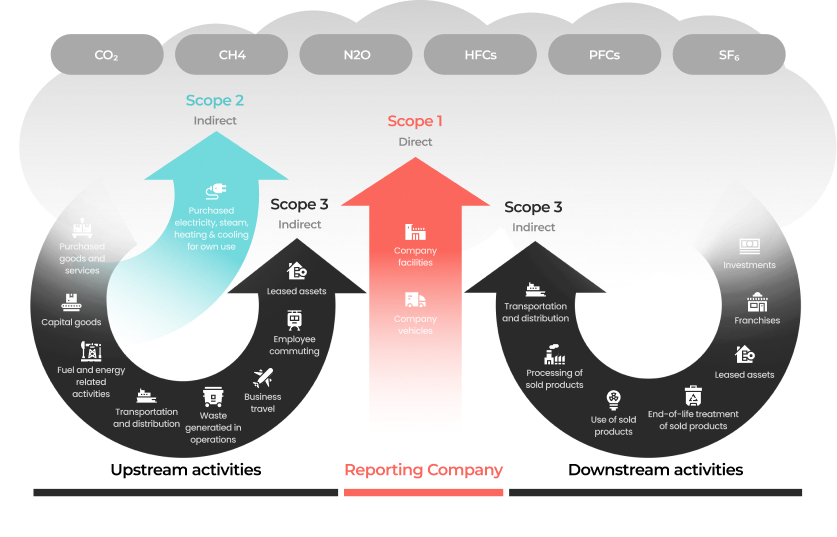

Scope 3
(Other indirect emissions)Definition
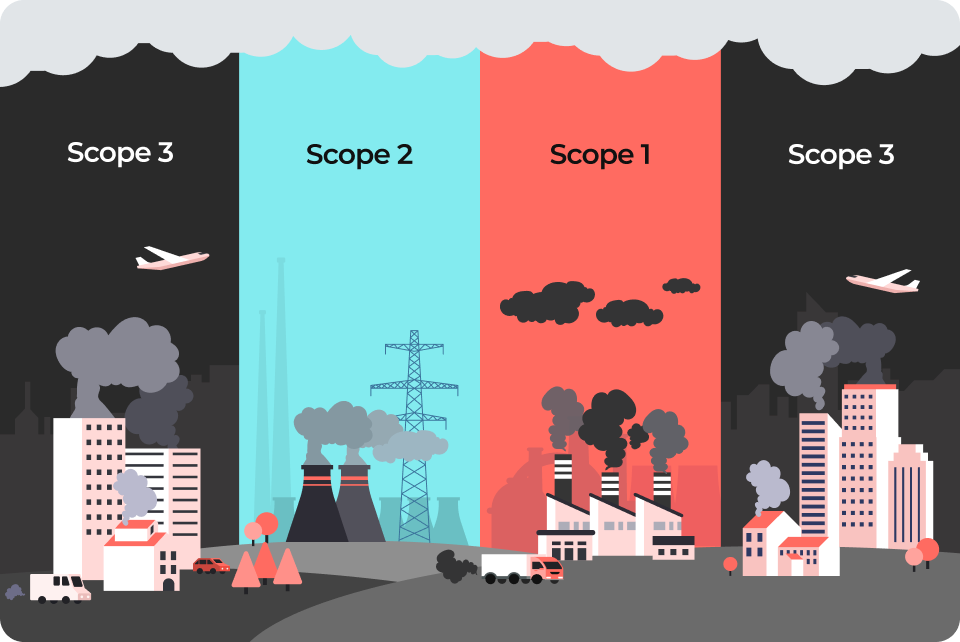
It is a system in which a professional verification body evaluates and confirms whether indirect greenhouse gas emissions (Scope 3) occurring throughout a company's entire supply chain are accurately calculated and managed. Scope 3 emissions include all indirect emissions occurring outside the company, such as raw material purchases, logistics/transportation, and product use and disposal. Through this verification, companies can systematically manage and transparently disclose the environmental impact of their entire supply chain.
GHG Protocol Scope 3 Categories
Upstream activities
| Category | Calculation Method (Example) | Note |
|---|---|---|
| 1. Purchased goods and services | Quantity or amount of raw materials purchased X Emission factor of raw material production | Product |
| 2. Capital goods | Purchase amount of products X Emission factor by industry classification | - |
| 3. Fuel and energy-related activities | Quantity of raw materials (electricity) purchased X Emission factor | Product |
| 4. Upstream transportation and distribution | Quantity of raw materials purchased X Transportation distance X Emission factor | Product |
| 5. Waste generated in operations | Waste treatment volume (ton) X Emission factor by property | Product |
| 6. Business travel | Travel distance, fuel amount X Emission factor (CO2/km) | - |
| 7. Employee commuting | Number of employees X Commuting distance, fuel amount X Emission factor | - |
| 8. Upstream leased assets | Size of leased asset (m2) X Emission factor (tCO2/m2) | - |
Downstream activities
| Category | Calculation Method (Example) | Note |
|---|---|---|
| 9. Downstream transportation and distribution | Quantity of raw materials purchased X Transportation distance (km) X Emission factor (CO2/km) | Product |
| 10. Processing of sold products | Quantity of sold products X Emission factor per unit | - |
| 11. Use of sold products | Number of sold products X Expected lifespan X Consumption amount | Product |
| 12. End-of-life treatment of sold products | Waste treatment volume (ton) X Emission factor by property | Product |
| 13. Downstream leased assets | Size of leased asset (m2) X Emission factor (tCO2/m2) | - |
| 14. Franchises | Number of franchises X Average power consumption per unit | - |
| 15. Investments | (Emissions / Sales) X Equity ratio (%) | - |
-
01 Public Trust
- Received Prime Minister and Minister Commendations a total of 6 times, Directly registered organization in Global Certification Scheme
- [Ministry of Environment - NIER]
Designated as a GHG Verification Body (Designation No. 2011-14) - [Ministry of Environment - NIER]
Accredited to ISO 17029:2019, ISO 14065:2020 (Accreditation No. 2023-EV-05) - [MOTIE - KOLAS]
Accredited to ISO 17029:2019 (Accreditation No. KVV 004) - [KoSIF]
Designated as a CDP Verification Body (Designation No. 9)
-
02 Expertise
- Largest number of domestic certifications and verifications (GHG, SR) (7,000 cases)
- Conducted numerous emission reduction performance verifications
-
03 Capacity &
Responsiveness- Possesses a large number of verification auditors
- Established a sufficient pool of qualified verifiers
- Timely communication throughout the verification process
KMR verification is systematically conducted based on know-how accumulated over many years.
We comply with verification standards and laws, and strictly separate duties between the verification operation department and the verification auditor office to meet the requirements for verification independence.
We comply with verification standards and laws, and strictly separate duties between the verification operation department and the verification auditor office to meet the requirements for verification independence.
Verification Overview Identification
- Document Review
- Risk Analysis
- Sampling Plan Establishment
- Verification Plan Establishment
- On-site Verification
- Corrective Action Confirmation & Technical Review (Issuance of Verification Opinion)
Issuance of Verification Report and Verification Opinion
Benefit 01
Secure reliability in promoting Carbon Neutrality and ESG management
Benefit 02
Establish a foundation to respond to clients' requests for carbon information
Benefit 03
Enhance credibility of disclosed data for ESG ratings and regulatory compliance
Carbon Neutrality Verification Center
Bae Seok-hyunCenter Director
- tel
-
02.6309.9049
Carbon Neutrality Verification Center
Yang Hye-jiResearcher
- tel
-
02.6309.9089