

- Our Business
Korea Forest Service Forest Carbon Verification
Korea Forest Service Forest Carbon Verification

Overview
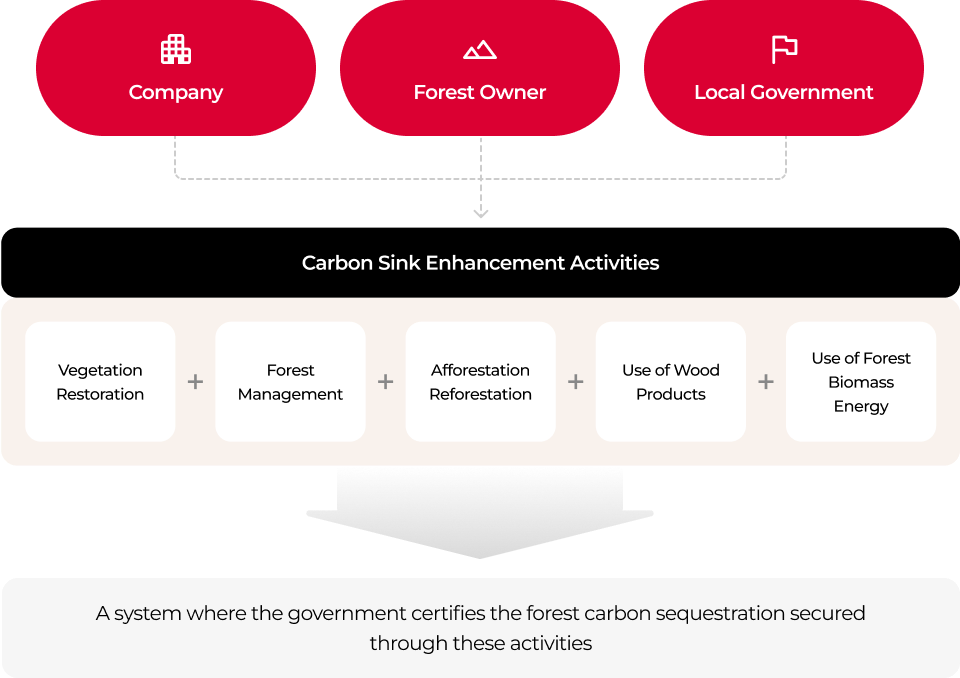
Utilization Methods
01
- Secure revenue from selling forest carbon sequestration
- Secure revenue by selling forest carbon sequestration to other organizations wishing to make social contribution donations
02
- Various corporate tax reduction benefits
- Promote social contribution activities and receive corporate tax reduction benefits
(Purchasing organizations burn/donate the sequestration amount after purchase) - Corporate tax reduction benefits for donation records
Project Operation
-
Afforestation/Reforestation
Concept Activities to create a forest through planting, sowing, and inducing natural regeneration in the target areaComparison by Participation Type-
Tradable Type
Afforestation : Land that has not been a forest for the past 50 years
Reforestation : Land that was originally a forest but was diverted to other uses before December 31, 1989, and has not been a forest since
-
Non-Tradable Type
Afforestation/Reforestation : Land that is not a forest at the time of starting the forest carbon offset project
-
-
Vegetation Restoration
Concept Activities to create urban forests, living forests (village forests, landscape forests, school forests), and street trees on non-forest landComparison by Participation Type-
Tradable Type
Cases where urban forests, living forests, and street trees under Article 2, Subparagraphs 4 to 6 of the 'Creation and Management of Forest Resources Act' are created on non-forest land of 0.05 ha or more that does not meet the requirements for afforestation/reforestation project sites
-
Non-Tradable Type
Cases that do not meet the requirements for tradable type project sites
-
-
Forest Management
Concept Activities to maintain forest health and induce vigorous growth to increase carbon sequestration through sustainable forest managementComparison by Participation Type-
Tradable Type
Forests with established forest management plans or those that have acquired forest certification
-
Non-Tradable Type
Forests capable of forest management
-
-
Restraint on Forest Land Conversion
Concept Activities to retain forests or create green spaces beyond the mandatory conservation area when converting forest landComparison by Participation Type-
Tradable Type
-
-
Non-Tradable Type
Considering that forest land conversion is an activity that removes existing carbon sinks, the restraint on forest land conversion is only recognized as a non-tradable type
-
-
Use of Wood Products
Concept Activities using wood products produced using timber harvested through legal proceduresComparison by Participation Type-
Tradable Type
Only the use of domestic timber is recognized, and when imported and domestic timber are mixed, only the domestic timber portion is recognized considering the mixing ratio
-
Non-Tradable Type
Imported timber can also be used
-
-
Use of Forest Biomass Energy
Concept Activities to reduce greenhouse gas emissions by replacing all or part of the previously used fossil fuels with forest biomass energy (wood pellets, wood chips, etc.)Comparison by Participation Type-
Tradable Type
Cases where greenhouse gas emissions are reduced by using domestic forest biomass energy
-
Non-Tradable Type
Imported forest biomass energy can also be used
-
-
Complex Project
Concept Utilizing wood products produced from activities such as afforestation/reforestation and forest management, or forestry by-productsComparison by Participation Type-
Tradable / Non-Tradable Common
Can participate as tradable or non-tradable types depending on the site and participation requirements of each unit project (afforestation/reforestation, forest management, use of wood products, use of forest biomass energy).
-
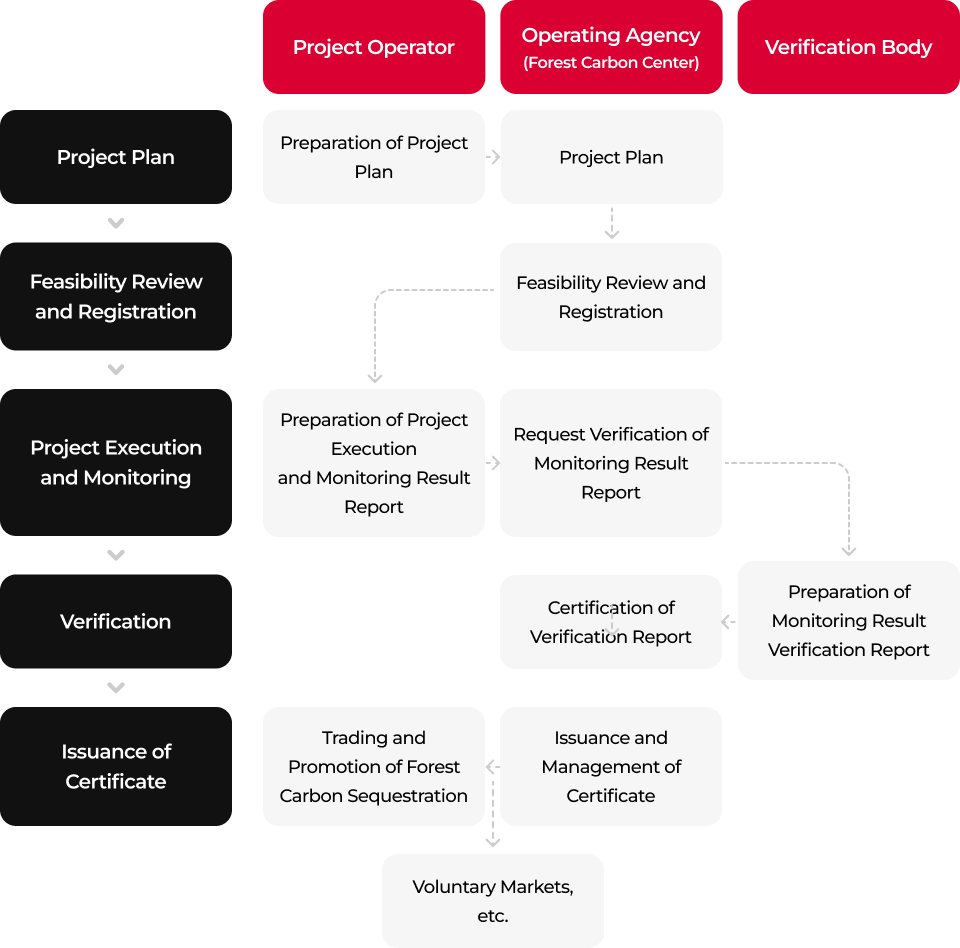
Verification Process
-
01 Public Trust
- Received Prime Minister and Minister Commendations a total of 6 times, Directly registered organization in Global Certification Scheme
- [Ministry of Environment - NIER]
Designated as a GHG Verification Body (Designation No. 2011-14) - [Ministry of Environment - NIER]
Accredited to ISO 17029:2019, ISO 14065:2020 (Accreditation No. 2023-EV-05) - [MOTIE - KOLAS]
Accredited to ISO 17029:2019 (Accreditation No. KVV 004) - [KoSIF]
Designated as a CDP Verification Body (Designation No. 9)
-
02 Expertise
- Largest number of domestic certifications and verifications (GHG, SR) (7,000 cases)
- Conducted numerous emission reduction performance verifications
-
03 Capacity &
Responsiveness- Possesses a large number of verification auditors
- Established a sufficient pool of qualified verifiers
- Timely communication throughout the verification process
We comply with verification standards and laws, and strictly separate duties between the verification operation department and the verification auditor office to meet the requirements for verification independence.
- Document Review
- Risk Analysis
- Sampling Plan Establishment
- Verification Plan Establishment
- On-site Verification
- Corrective Action Confirmation & Technical Review (Issuance of Verification Opinion)
Secure reliability in promoting Carbon Neutrality and ESG management
Establish a foundation to respond to clients' requests for carbon information
Enhance credibility of disclosed data for ESG ratings and regulatory compliance
Carbon Neutrality Verification Center
Bae Seok-hyun- tel
-
02.6309.9049
Carbon Neutrality Verification Center
Yang Hye-ji- tel
-
02.6309.9089